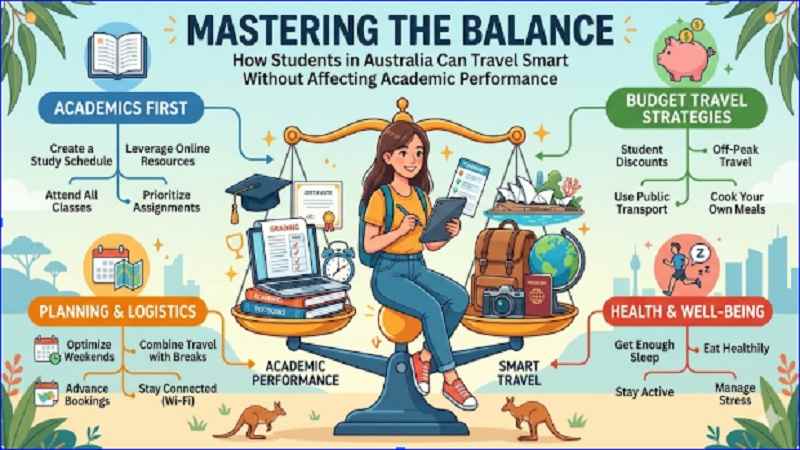
For many students in Australia, the desire to explore the vast landscapes of the Outback, the hidden gems of the Great Ocean Road, or the bustling laneways of Melbourne often clashes with the rigid demands of the academic calendar. The pressure of maintaining a high ATAR or keeping up with university-level units can make the idea of a getaway feel like a distant dream—or a recipe for academic disaster.
However, “traveling smart” isn’t just about finding cheap flights; it’s about strategic integration. In 2026, the boundary between the classroom and the world has blurred. Myassignmenthelp can assist in managing heavy workloads during your travels, the right personal frameworks ensure you can traverse the continent while keeping your academic performance on an upward trajectory.
1. The Blueprint: Aligning Your Itinerary with the Academic Calendar
The first step to traveling without academic guilt is timing. In the Australian education system, peak stress periods are predictable.
- For High School Students: Avoid the weeks leading up to trials or final HSC/VCE/SACE exams. Instead, leverage the term breaks in April and July. These are “consolidation phases” where you can switch from active learning to passive revision.
- For University Students: The “Mid-Semester Break” is often a misnomer; it is frequently a “Study Break.” To travel during this time, you must front-load your assignments.
- The “Safe Zone” Strategy: Identify periods where no major assessments are due within seven days of your return. This buffer is essential for overcoming “travel fatigue” and refocusing your brain on your studies.
2. Leveraging Digital Nomad Workflows for Students
If you are traveling during the semester, you must adopt a “Student Nomad” mindset. This means moving away from binge-studying and toward consistent, high-intensity intervals.
Deep Work on the Go
The concept of “Deep Work” involves shifting into a state of distraction-free concentration. When traveling, your environment is unpredictable. Use noise-canceling headphones and dedicated apps to block social media. If you find yourself struggling with complex quantitative tasks while on the road, seeking specialized managerial accounting assignment help can free up the mental space needed to focus on your travel experience without falling behind.
The Pomodoro Technique for Sightseeing
To balance sightseeing with study, use a modified Pomodoro technique. Dedicate three hours in the morning (8:00 AM – 11:00 AM) to high-priority academic tasks. Once those sessions are complete, the rest of the day belongs to exploration. This removes the “background anxiety” that often ruins a holiday.
3. Financial Literacy: Travel Smart, Live Smart
In the current economic climate, Australian students must navigate HECS-HELP debts and rising living costs.
- Student ID Power: Your student ID is your most valuable travel document. From discounted Jetstar or Qantas student fares to cheaper entry at the Port Arthur Historic Site, always ask for the student rate.
- Off-Peak Exploration: Australia is expensive during school holidays. If you are a university student, try to travel during the “shoulder seasons” in February or October when flights are cheaper and the weather is still conducive to travel.
4. The Digital Academic Safety Net: When to Seek Support
The biggest risk to academic performance while traveling is falling behind on complex, cumulative modules. For students tackling quantitative or detail-heavy subjects like Law, Statistics, or Managerial Accounting, missing even a week of lectures can lead to a “knowledge gap” that snowballs by finals week.
Auditing Your Syllabus
Before you depart, audit your syllabus. If you see a major “Managerial Accounting” project or a “Statistics” data analysis due while you are away, don’t leave it to the last minute.
Utilizing Expert Scaffolding
Sometimes, despite the best planning, deadlines overlap with once-in-a-lifetime opportunities. In these instances, leveraging professional academic resources acts as a vital safety net. Utilizing statistics assignment help or specialized guidance for complex case studies ensures that you don’t return to a failing grade. These platforms provide the scaffolding needed to maintain your GPA while you gain the life experiences that travel provides.
5. Regional Benchmarks: Understanding Your Goals
Your travel strategy should change based on your specific academic goals in the Australian system.
- ATAR Aspirants: If you are aiming for a 90+ ATAR, your travel should be “low-cognition.” Avoid learning new, complex topics while away. Instead, use your travel time to consolidate existing knowledge.
- University Students: Focus on “Project Management.” Treat your semester like a series of sprints. If you want a week off in Hobart, you must finish your 2,000-word essay two weeks early.
6. The “Agentic” Approach to Learning and Travel
In 2026, we will talk a lot about “Agentic Literacy”—the ability to use tools (including AI and digital platforms) to manage your own life and learning.
- Use AI to summarize long readings into bite-sized audio files you can listen to while walking through a new city.
- Use digital research coordinators to organize your references while you are away from your desk.
7. Health and Wellbeing: The Hidden Factor
Travel can be exhausting. If you return to campus burnt out, your academic performance will suffer regardless of how much you studied on the plane.
- Stay Hydrated and Active: Use the natural beauty of Australia to stay fit. A hike in the Blue Mountains or a swim at Bondi isn’t just “fun”—it’s a way to clear cortisol and reset your brain.
- Sleep Hygiene: Don’t sacrifice sleep for late-night festivities if you have a seminar the day you return. Maintain a consistent sleep schedule to keep your cognitive functions sharp.
8. Packing for Success: The Student Traveler’s Kit
What you carry determines how effectively you can work. A “Travel Smart” kit for an Australian student includes:
- A lightweight tablet or laptop with offline access to your LMS (Canvas, Blackboard, or Moodle).
- A high-capacity power bank for long regional train or bus trips.
- Physical summaries of your most difficult subjects (e.g., Law statutes or Accounting formulas).
- A portable Wi-Fi hotspot, as regional Australian internet can be notoriously “patchy.”
9. Connecting the Dots: Why Travel Matters for Your Career
While your GPA is important, employers in Australia and abroad look for well-rounded individuals. Travel builds “Soft Skills” that a textbook cannot teach:
- Adaptability: Dealing with a cancelled flight to Cairns.
- Budget Management: Making a week’s worth of HECS-funded savings last in Sydney.
- Intercultural Communication: Meeting international students in hostels.
Frequently Asked Questions
Q.1 How can I maintain my Overseas Student Health Cover (OSHC) while traveling interstate?
Your OSHC is valid Australia-wide. Whether you are surfing in Byron Bay or hiking the Larapinta Trail, you are covered for doctor consultations and hospital treatment. However, if you are traveling to remote areas, always locate the nearest “Direct Billing” clinic via your provider’s app (like Allianz or Bupa) to avoid out-of-pocket expenses.
Q.2 What are the specific visa conditions for traveling during the semester in 2026?
Under Subclass 500, the most critical condition is maintaining “Satisfactory Academic Progress.” As long as you are attending your required seminars (physically or digitally) and passing your units, traveling within Australia is perfectly fine. However, if you fall behind in high-stakes subjects like Statistics or Managerial Accounting, you risk a “Show Cause” notice, which could impact your visa status. This is why having an academic safety net is not just helpful—it’s a compliance strategy.
Q.3 Are there specific “Study Hubs” in regional Australia for travelers?
Yes. If you find your hostel too noisy for Deep Work, look for local “Library Hubs” or university regional campuses (like UNE or CSU). Most Australian regional libraries offer free high-speed Wi-Fi and dedicated quiet zones. In major cities like Adelaide or Perth, public transport “Free Wi-Fi Zones” are also a great way to squeeze in some Active Recall during your commute.
Conclusion: The Integrated Student Life
Traveling as a student in Australia doesn’t have to be an “either/or” proposition. By using productivity frameworks like Time-Boxing, staying ahead of your syllabus, and knowing when to use academic support services for your more challenging units, you can enjoy the best of both worlds. Plan early, work deeply, and explore widely.